

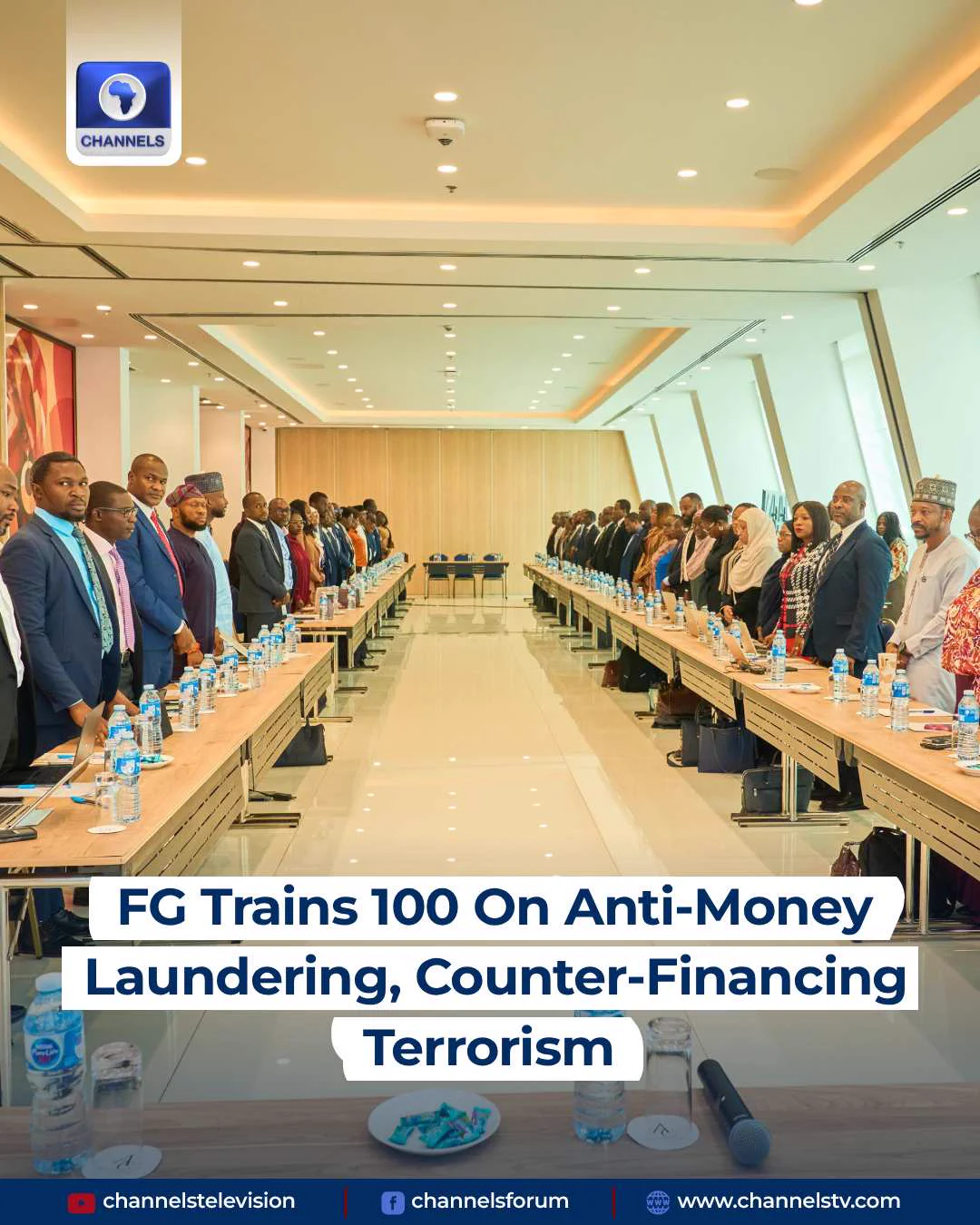
Nigeria don begin five-day training for 100 members of the country’s Mutual Evaluation Working Groups (MEWG) to strengthen the country’s preparation for the next round of assessment on how well e dey fight money laundering, funding of terrorism and financing of weapons wey fit cause mass destruction.
The Nigerian Financial Intelligence Unit (NFIU) Chief Executive Officer, Hafsat Abubakar Bakari, disclose this for statement, explaining say the training na Inter-Governmental Action Group against Money Laundering in West Africa (GIABA) organise am, with support from SecFIN Africa after Nigeria request for assistance.
The training dey hold for Abuja from October 12 to 16, 2026. E go help participants understand how the assessment go take place and prepare dem for the national practice assessment wey government plan to hold for November 2026.
She explain say the training follow Nigeria successful removal from the Financial Action Task Force (FATF) Grey List for October 2025, adding say the country still dey work to make its financial system stronger and more trustworthy.
Representing GIABA Director General, Giwa Siman Sechap, the organisation’s Director of Evaluations and Compliance, stress say all the agencies involved need to understand how the assessment work and provide correct evidence to show the progress wey Nigeria don make.
E explain say the assessment na responsibility wey concern the whole country, and Nigeria must show not only say e get the right laws, but say those laws dey produce results.
Professor Shehu Abdullahi, SecFIN Africa Country Representative, also talk say government agencies need to work together, share correct information and take responsibility to prepare the country well for the assessment.
E add say the training go help Nigeria identify areas wey need improvement, build on the progress wey e don make and show how well the country dey protect its financial system from crime.
The training bring together representatives from different government agencies wey dey help Nigeria fight financial crimes and protect the country’s economy.
The agencies include Bureau of Public Procurement (BPP), Central Bank of Nigeria (CBN), Code of Conduct Bureau (CCB), Corporate Affairs Commission (CAC), Defence Intelligence Agency (DIA), Department of State Services (DSS), Economic and Financial Crimes Commission (EFCC), Federal Ministry of Justice and Independent Corrupt Practices and Other Related Offences Commission (ICPC).
Others include Mining Cadastral Office (MCO), National Agency for the Prohibition of Trafficking in Persons (NAPTIP), National Counter Terrorism Centre (NCTC) and National Drug Law Enforcement Agency (NDLEA).
Representatives from National Insurance Commission (NAICOM), Nigerian Financial Intelligence Unit (NFIU), Nigeria Customs Service (NCS), Nigeria Export Processing Zones Authority (NEPZA), Nigeria Extractive Industries Transparency Initiative (NEITI), Nigeria Police Force (NPF), Nigeria Revenue Service (NRS) and Nigeria Security and Civil Defence Corps (NSCDC) also dey take part.
Other agencies wey dey involved include Oil and Gas Free Zones Authority (OGFZA), Securities and Exchange Commission (SEC) and Special Control Unit Against Money Laundering (SCUML), among others.
The agencies go share their knowledge and experience on financial intelligence, monitoring of financial institutions, reporting of suspicious transactions, investigation and prosecution of criminals, recovery of stolen money and assets, border security, identification of people wey truly own businesses and protection of national security.
NFIU explain say the cooperation of all these agencies go help Nigeria show say the system wey e use to fight money laundering and terrorism funding dey produce clear results.
For the past two years, Nigeria don increase the number of its experts wey getinternational qualification on FATF standards from fewer than 10 to 25.
The current training na part of a bigger plan to build the skills of more people wey dey work to prevent financial crimes. Government dey consider holding more training every three months for groups of 100 to 150 participants, with the possibility of extending the programme to private companies in the future.
The training go cover how to gather and study financial information, monitor financial institutions, deal with virtual assets, identify the real owners of businesses, investigate and prosecute criminals, seize assets linked to crime and work with other countries to fight financial crimes.
Participants go also learn about financial restrictions wey government fit place on people or groups involved in terrorism and the risks linked to funding the spread of dangerous weapons.
The programme go include practical exercises and mock interviews to prepare participants to answer questions from assessors with correct information and evidence wey dem fit verify.
The training also dey build on the national review and gap analysis wey NFIU coordinate with support from EFCC, DSS, ICPC, CBN, NAICOM and SEC through the Inter-Ministerial Committee (IMC).
The review check how well Nigeria dey carry out its plans to fight financial crimes, identify areas wey need more work and set priorities for improvement.
The NFIU boss explain say the joint effort go help all the agencies understand their responsibilities and work together to strengthen Nigeria’s system for fighting money laundering, terrorism funding and other related financial crimes.
She add say the main aim na to turn the work wey all the agencies dey do into clear and measurable improvements, so Nigeria go fit detect and stop financial crimes more effectively.
The initiative show say Nigeria dey continue to strengthen cooperation among government agencies and improve their ability to fight financial crimes ahead of the next international assessment.